
Author: Vikram Sharma, Lead SEO & Content Strategist at Marketing Specs, Delhi
Published/Updated: June 2026
Expertise Verified By: Marketing Specs Editorial Board (10+ Years in Search & Social Ecosystems)
Quick Summary for Busy Marketers: In 2026, social media optimization is no longer just about posting consistently; it is about turning your social profiles into highly searchable, high-intent discovery engines. By shifting from cold broadcasting to human-first community engagement and optimizing your platforms for social search algorithms, you can capture up to 40% more non-follower traffic.
The digital landscape has fundamentally transformed over the past few years. As an agency based in the heart of Delhi, our team at Marketing Specs has spent the last five years auditing, testing, and scaling organic social frameworks for over 150 brands across India and global markets. If there is one reality we face daily on the ground, it is this: traditional search engine optimization and social channels have merged.
Today, millions of users treat platforms like Instagram, TikTok, and YouTube as primary search engines. If your brand does not show up when a user types a high-intent query into a social search bar, you are practically invisible. This brings us to a crucial element of digital survival: mastering social media optimization.
In this extensive, deep-dive playbook, we will break down exactly how to structure your brand’s presence to dominate organic search feeds, satisfy Google’s strict E-E-A-T guidelines, explore advanced optimization frameworks, and convert passive scrollers into passionate brand advocates.

What is SMO? Understanding the Core Foundation
To build a high-converting digital footprint, we must first return to the foundational definitions that govern online visibility. Many business owners ask our consultancy team: what is SMO and how does it differ from traditional social media marketing?
Let us define it clearly:
- Definition: SMO stands for Social Media Optimization. It is the systematic process of refining, structuring, and optimizing your social media profiles and content assets to maximize organic visibility, discoverability, and engagement.
- The Search Connection: Just as web SEO optimizes a website to rank on Google search result pages, what is SMO at its core is the practice of optimizing your social handles so they rank within internal social network search engines and external search indexers.
- The Structural Core: It focuses heavily on profile completeness, natural keyword placement within bios and captions, strategic asset management, and cross-channel link building.
While standard marketing focuses on running paid ad campaigns or pushing promotional creatives, social media optimization looks at the algorithmic health of your organic channels. It ensures that the content you create actually reaches the right eyes without requiring an ad budget to stay afloat. Understanding what is SMO enables brands to build sustainable traffic networks that do not crash the moment an advertising budget runs dry.
Why Social Media Optimization Rules the Discovery Era
The internet is currently facing a massive shift toward multi-modal discovery. Consumers no longer rely solely on traditional search engines to make purchasing decisions. They want to see real people, live demonstrations, and authentic micro-interactions before handing over their hard-earned money.
Here is why your brand needs to invest heavily in a dedicated social media optimization framework right now:
- The Rise of Social Search: Up to 24% of consumers now look for local businesses, product reviews, and educational guides directly through social discovery bars instead of Google.
- Algorithmic Longevity: Unoptimized posts disappear from user feeds within 24 to 48 hours. However, a post backed by excellent social media optimization continues to appear in search results for months after its initial publication date.
- Enhanced Web Authority: Google’s crawling systems actively index high-quality, public social content. A highly optimized social presence acts as a powerful trust signal, strengthening your website’s overall domain authority.
- Direct-to-Consumer Commerce: With in-app shopping features and shoppable video content fully mainstream, your social profiles serve as modern storefronts. Optimization removes the friction between product discovery and terminal checkout.
Step-by-Step Playbook for Modern Social Media Optimization
Through our years of refining growth strategies at Marketing Specs, we have developed a repeatable, four-stage optimization framework that consistently outperforms generic posting schedules. Let us look at the exact operational steps required to modernize your channels.
1. Profile Architecture & Identity Alignment
Before you publish a single post, your profiles must be structurally sound. Think of your profile bio as the meta-description of your social brand.
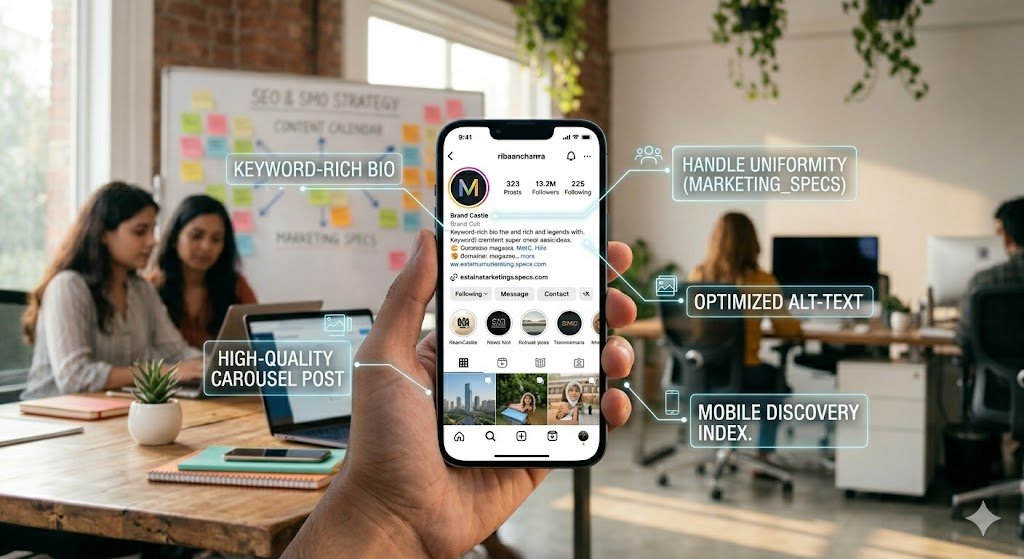
- Handle Uniformity: Ensure your username is consistent across Instagram, LinkedIn, YouTube, and X. This builds immediate cross-platform recognition for your brand name.
- Keyword-Rich Bios: Naturally weave your primary focus terms into your bio section. For example, if you run a fitness brand, your bio should explicitly include phrases like “Custom Workout Routines” or “Plant-Based Nutrition Guides.”
- The Anchor Link Strategy: Never leave your bio link blank. Use tracking-enabled links or dedicated landing page aggregators to route social traffic to high-value areas of your website.
2. Crafting for Social SEO Discovery
To rank within platform feeds, your content assets must provide explicit text contextual signals that algorithmic crawlers can easily parse and categorize.
- Caption Optimization: Treat your captions as micro-blogs. Write descriptive, engaging text that includes natural variations of your core industry topics.
- Spoken Keyword Integration: Modern video algorithms automatically transcribe spoken audio. Ensure your creators say your primary keywords within the first three seconds of a video clip.
- Alt-Text Implementation: Manually edit the advanced settings of your photo and carousel posts to include descriptive image alt-text. This directly aids visual search indexing.
3. The Shift to Human-Centric Content Assets
Audiences no longer connect with overly polished, faceless corporate logos. The highest-performing assets are deeply human, raw, and experiential.
- Founder & Employee Advocacy: Introduce real faces behind your corporate operations. Let your team share behind-the-scenes struggles, workflow breakdowns, and day-to-day lessons.
- User-Generated Content (UGC): Actively showcase real reviews, unboxing videos, and community screenshots. This builds immense social proof that cannot be artificially manufactured.
- Value-Dense Carousels: Package complex industry tutorials into scannable multi-slide visual guides. Audiences frequently save these assets, which sends massive positive signals to distribution algorithms.
4. Advanced Keyword Mapping for Social Intent
Social search intent looks completely different from web-based search queries. When users search social apps, they look for immediate execution steps, raw proof, or visual inspiration. To scale your social media optimization, implement an intent-based keyword map:
- Inspirational Intent: Use broad, highly visual phrases in your Pinterest and Instagram video content (e.g., “Minimalist Office Setup Ideas”).
- Educational Intent: Target long-tail informational questions on YouTube and TikTok (e.g., “How to set up Google Tag Manager for e-commerce”).
- Commercial Intent: Optimize your bio links, showcase product highlights, and integrate transactional terms on LinkedIn and Instagram (e.g., “Book a Free Content Strategy Consultation”).
Evaluating “What is SMO” vs. Traditional Web SEO
A common point of confusion we clear up during client onboarding sessions at our Delhi office involves understanding how web-based search strategies interact with profile optimization. While they share similar goals, their technical executions are distinct.
| Feature Strategy | Web Search Engine Optimization (SEO) | Social Media Optimization (SMO) |
| Primary Platform Target | Google, Bing, Yahoo Search Engine Indexers | Instagram, LinkedIn, YouTube, Meta Feeds |
| Content Lifecycle | Months to Years (Long-term compounding value) | Days to Months (Dependent on search intent and saves) |
| Success Metrics | Organic Traffic, Backlinks, Domain Rating, Keyword Ranks | Shares, Saves, Profile Discovery, DM Leads, Community Velocity |
| Technical Focus | Schema Markup, Core Web Vitals, HTML Hierarchy, Site Speed | Bio Context, Alt-Text, Spoken Keywords, Caption Length |
By implementing both methodologies simultaneously, you create an omni-channel marketing loop. Your web SEO efforts draw high-intent users from search engine result pages, while your social media optimization retains, nurtures, and converts that audience within interactive social ecosystems. When client organizations fully grasp what is SMO alongside traditional search mechanics, they can command the entire digital discovery landscape.

Deep Dive: The Technical Pillars of Social Search Engine Algorithms
To unlock the true power of social media optimization, we must look under the hood of the platforms we interact with daily. Modern algorithms are no longer randomized chronological feeds; they are complex semantic engines that parse multiple layers of data.
Semantic Underpinning & Natural Language Processing (NLP)
Platforms use advanced NLP models to scan your captions, video transcripts, and comments sections. If your caption reads like an uninspired sales brochure, the algorithm struggles to categorize it. However, by treating your content descriptions as authoritative micro-resources, you provide the precise contextual taxonomy required to match your posts with high-intent users.
Engagement Velocity vs. Engagement Depth
Historically, social platforms tracked simple engagement velocity (how fast a post gathered initial likes). In 2026, the priority has shifted completely to engagement depth.
- Dwell Time: The number of seconds or minutes a user stops scrolling to consume your text or video asset.
- Save Ratio: The percentage of viewers who archive your content for future reference. This is the single highest algorithmic validation for quality.
- Share Metrics: How many users forward your asset to their personal networks via direct messages or external apps.
Aligning Your Social Optimization with Google’s E-E-A-T
Google’s search systems evaluate content based on the framework of Experience, Expertise, Authoritativeness, and Trustworthiness (E-E-A-T). This quality framework applies heavily to how your brand represents itself across all public digital spaces, including your social media footprints.
Here is how you can systematically construct undeniable E-E-A-T signals through strategic social media optimization:
Documenting Lived Experience
Algorithms increasingly prioritize first-hand, lived experience over compiled theoretical knowledge.
- Case Study Sharing: Instead of posting generic industry tips, publish micro case studies outlining real campaigns. Detail the exact challenges faced, timelines managed, and quantitative results achieved.
- Process Transparency: Share raw documentation of your product creation or service delivery. Show your audience the exact tools, methodologies, and quality checks you utilize behind closed doors.
Showcasing Real-World Expertise
Establish your content creators as credible, undeniable voices within your specific niche.
- Verified Content Authorship: Ensure your posts are tied back to real individuals with recognizable professional backgrounds. Link your social content to comprehensive author bios on your main website.
- Technical Precision: Avoid surface-level generalizations. Dive deep into complex industry mechanics, define technical terms clearly for your audience, and address common market misconceptions directly.
Building Long-Term Trust & Authority
Trust is the ultimate anchor of the E-E-A-T framework. Without it, your visibility cannot endure algorithm shifts.
- Active Community Accountability: Use the comments and direct message sections as spaces for genuine, two-way communication. Answer customer queries with complete accuracy and transparent honesty.
- Verified External References: When referencing industry statistics or making bold market claims, explicitly cite primary research documents, government data, or respected academic studies.
Platforms to Prioritize for Maximum Optimization ROI
Not all platforms require the same optimization tactics. Depending on your business model, you should distribute your resources across channels that yield the highest conversion velocity.
Instagram: The Visual Community Hub
- Optimization Blueprint: Focus heavily on high-value carousels and authentic reels. Use descriptive captions that dive deep into the context of the visual asset. Optimize your “Highlights” section as dedicated website categories.
- Algorithmic Trigger: Maximize user saves and shares by creating highly educational infographics that users will want to reference multiple times.
LinkedIn: The B2B Authority Engine
- Optimization Blueprint: Optimize your personal and company profiles with clear industry taglines. Publish long-form, thought-leadership text posts paired with custom PDF slide decks.
- Algorithmic Trigger: Write deeply insightful commentary that encourages professional dialogue within the comments section. Meaningful conversational depth drives long-term feed distribution here.
YouTube: The Long-Form Search Powerhouse
- Optimization Blueprint: Treat YouTube as a literal video search engine. Conduct thorough keyword research before filming, place your target phrases in titles and video chapters, and create high-contrast custom thumbnails.
- Algorithmic Trigger: Maintain high audience watch time and viewer retention rates by delivering clear, immediate answers right at the start of your videos.
Meta (Facebook): The Local Discovery Landscape
- Optimization Blueprint: For businesses looking to capture local market share, optimizing your Facebook business page with precise location markers, phone details, and operational hours is essential.
- Algorithmic Trigger: High volumes of positive community recommendations and direct user check-ins signal localized authority to the platform’s feed indexers.

The Essential SMO Tool Stack for 2026
Executing a world-class social media optimization framework at scale requires the right technological infrastructure. At Marketing Specs, our day-to-day workflow relies on an advanced combination of search, asset management, and analytics suites:
1. Keyword Discovery & Listening Tools
- AnswerThePublic & AnswerTheSocial: Excellent for mining long-tail questions that consumers type directly into social app search bars.
- Google Trends: Used to monitor real-time viral breakout search queries, helping you align your content assets with current public interest waves.
2. Asset Structure & Optimization Software
- Figma / Canva Enterprise: Crucial for maintaining strict visual identity guidelines across multi-slide carousels, custom headers, and profile banners.
- CapCut Pro / Adobe Premiere: Used to embed automated, highly accurate burnt-in open captions, ensuring video accessibility and keyword indexability when sound is turned off.
3. Analytics & Distribution Command Centers
- Sprout Social / Hootsuite: Essential for unified profile scheduling, direct message workflow mapping, and tracking response time metrics.
- Google Analytics 4 (GA4): Used to build custom UTM parameter funnels, allowing you to track exactly how much organic website traffic originates from your optimized bios.
Common Pitfalls in Social Optimization (And How to Avoid Them)
Even seasoned digital marketers make critical errors that inadvertently limit their organic reach. Avoid these major execution mistakes:
- Aggressive Keyword Stuffing: Packing your captions with random lists of unrelated terms looks spammy to users and gets flagged by modern semantic algorithms. Always prioritize fluid, natural language.
- Neglecting Community Comments: Treating social channels like a one-way megaphone destroys your engagement metrics. Dedicate real human hours to responding to your audience within the first hour of every upload.
- Ignoring Analytics Data: Don’t post based on pure guesswork. Audit your performance metrics weekly to analyze exactly which topics drive the highest saves, profile visits, and direct message inquiries.
- Siloing Your Marketing Efforts: Keeping your social optimization separate from your website SEO is a huge error. Let your search data inform your social strategy, and feed your social assets back into your website’s content layout.
The Operational Workflow for Scaling Organic Social Visibility
To turn these strategies into sustainable business growth, your marketing team needs a structured, predictable production schedule. Here is the operational workflow we use internally at Marketing Specs to keep optimization workflows running efficiently:
[Content Pillar Ideation]
           │
           ▼
[Keyword Strategy & Scripting] (Integrating Spoken and Written Keywords)
           │
           ▼
[Human-First Production] (Capturing Raw Behind-the-Scenes & Real Experience)
           │
           ▼
[Platform Optimization] (Adding Alt-Text, Chapters, Bio Links, & Captions)
           │
           ▼
[Community Nurturing] (Responding to DMs, Comments, & Building Private Groups)
By following this loop, you ensure that every asset your team produces is fully prepared to rank, engage, and convert across the digital ecosystem.
Measuring SMO: The Modern KPI Framework
What gets measured gets managed. To justify your team’s focus on organic social media optimization, look beyond vanity follower increments and track deep conversion metrics.
       [Organic Visibility] ──> Impressions, Social Search Ranks, Profile Visits
                │
                ▼
       [Audience Valuation] ──> Content Saves, Detailed Comments, Asset Shares
                │
                ▼
      [Business Conversion] ──> Bio Link Clicks, Inbound DMs, Website Leads
- The Save-to-Impression Ratio: Aim for a minimum 2% save rate on educational carousel and video assets. This proves your content holds long-term transactional value for the audience.
- Inbound Lead Velocity: Monitor how many organic direct messages contain specific, high-intent inquiries about your premium services or product collections.
- Brand Search Volume Lift: Track the growth of your company name queries inside Google Search Console. A successful social optimization framework always triggers a parallel surge in branded web search engine queries.
Frequently Asked Questions (FAQ)
What is the difference between SMO and SMM?
While both terms deal with social media, they cover different approaches. SMM (Social Media Marketing) is an umbrella term that often includes paid advertising campaigns, budget management, and broad promotional broadcasting. On the other hand, SMO (Social Media Optimization) focuses specifically on enhancing organic discoverability, technical profile setups, profile search engine visibility, and building long-term community assets without relying heavily on ad spend. Knowing what is SMO helps you maximize your baseline organic authority before spending a single dollar on running paid ads.
How do I measure the success of my social media optimization campaigns?
Success in optimization goes far beyond tracking vanity metrics like generic follower counts. You should measure performance through high-intent indicators: look closely at your volume of profile saves, content shares, organic profile views via search discovery features, inbound direct message leads, and click-through rates on your bio tracking links.
Does social media optimization directly affect my website’s Google rankings?
Social signals are not a direct, traditional mathematical ranking factor inside Google’s web core algorithms. However, a robust optimization framework creates a compounding positive effect: it increases overall brand searches on Google, earns valuable natural mentions across authoritative third-party websites, and ensures your public social profiles rank prominently when users search for your brand name online.
How often should I perform a comprehensive profile optimization audit?
We highly recommend running a thorough technical profile and asset audit once every quarter. This allows you to update your anchor links, refresh your biography keywords based on changing seasonal search trends, ensure complete visual branding consistency, and realign your content pillars with your latest business objectives.
Can AI completely handle my brand’s social media optimization?
AI tools are incredibly powerful for assisting with conceptual keyword ideation, analyzing audience analytics data, and structuring baseline content outlines. However, AI cannot replicate genuine human lived experience, raw behind-the-scenes authenticity, or the deep emotional intelligence required to build trusted communities. A hybrid model—where AI scales the operational workflow but real human experts inject actual experience and review the final output—is the winning formula.
What is the role of hashtags in modern social media optimization?
Hashtags no longer act as magical traffic triggers. Instead, modern platforms view hashtags as supplementary indexing tags. Instead of using generic, hyper-competitive phrases (like #Marketing), use highly targeted, descriptive multi-word tags (like #DigitalMarketingAgencyDelhi) that match precise niche consumer intentions.
Conclusion: Future-Proof Your Brand Identity
As we navigate through the digital realities of this year, relying on unoptimized, disconnected social posts will only lead to declining organic reach. True digital authority belongs to brands that treat their social profiles with the same analytical precision as their main corporate websites.
By clearly understanding what is SMO, implementing search-friendly architectural setups, and consistently creating content rooted in genuine human experience, you satisfy both modern algorithm requirements and human trust preferences.
Stop treating your platforms like simple billboards. Start optimizing your channels for authentic discovery, and let your community grow your business organically.
Need help transforming your brand’s organic presence? Connect with our dedicated social strategy team at Marketing Specs, Delhi, to schedule a comprehensive digital footprint audit.